

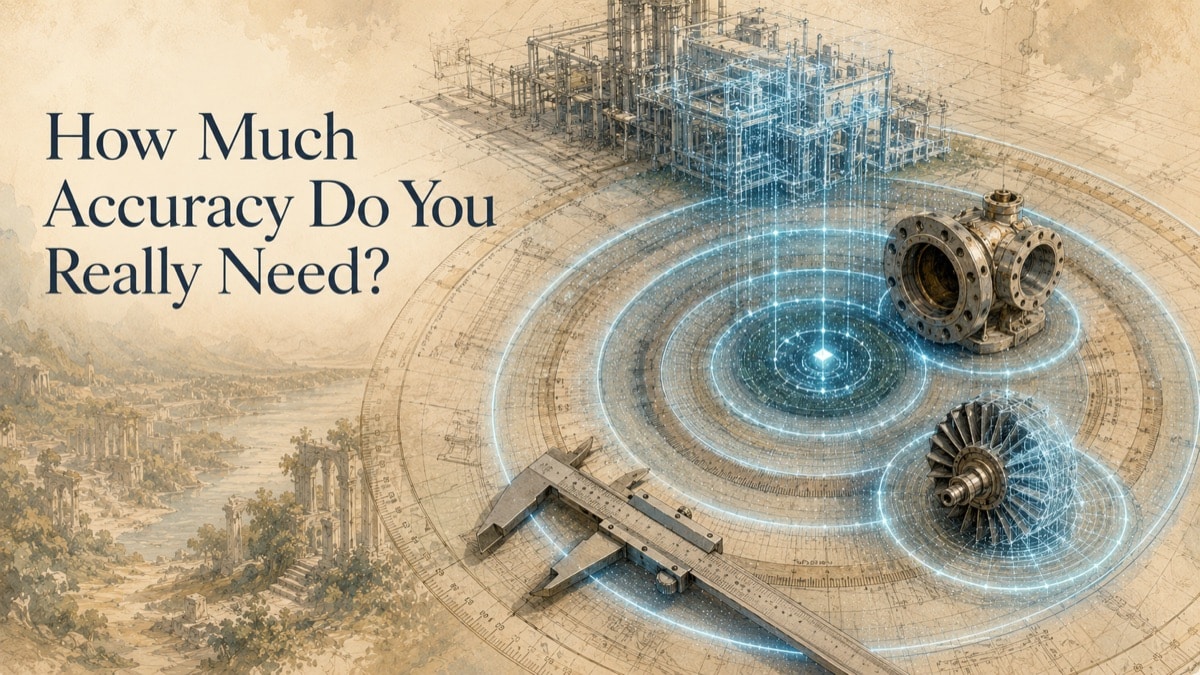
A buyer says they need the most accurate scan possible. The real question is more specific: do they need room layout, pipe routing, a flange centerline, an artwork mesh, or supplier inspection evidence? Each answer changes the workflow.
This is why GDS treats scanning as a decision-support workflow, not just a technical field activity. The question is not simply, "Can we scan it?" The more useful question is, "What decision must the data support, and what evidence will make that decision safer?"
Key Takeaway
How Much Accuracy Do You Really Need? is a decision framework, not just a technical term. Define the use, inputs, deliverable, limitations, and review responsibility before teams rely on the data.
The Practical Problem Behind How Much Accuracy Do You Really Need?
A buyer says they need the most accurate scan possible. The real question is more specific: do they need room layout, pipe routing, a flange centerline, an artwork mesh, or supplier inspection evidence? Each answer changes the workflow. This is why the topic belongs in the planning conversation before fieldwork, modeling, or procurement begins.
The strongest projects separate what is known, what is measured, what is modeled, and what still requires judgment. That protects the client and the service provider because the deliverable becomes evidence with context, not an implied guarantee beyond the approved scope.
What the Scan or Data Package Should Resolve
The useful scope starts with the decision. Teams should identify the required output, target software, accuracy expectations, workflow owner, and what happens if the information is wrong or late. The deliverable should distinguish measured evidence, modeled interpretation, assumptions, exclusions, and required reviews.
A good article page should help the reader choose the right next step. For some projects, that may be a broad spatial baseline. For others, it may be a focused interface scan, a lightweight model, a textured asset, a deviation report, or a consulting engagement before any field capture begins.
The Five-Phase Accuracy Planning Framework
Phase 1 - Define the decision
Tie accuracy to what the project must determine.
Phase 2 - Identify critical features
Separate high-consequence interfaces from broad context.
Phase 3 - Select capture and verification method
Choose equipment, station geometry, control, and checks based on the required confidence.
Phase 4 - State uncertainty and limitations
Document surfaces, range, access, alignment, and modeled interpretation.
Phase 5 - Review against the decision
Confirm the deliverable is adequate before teams rely on it.
Deliverable Strategy
| Deliverable Type | When It Helps | Key Control |
|---|---|---|
| Registered point cloud | Preserves measured visible conditions as source evidence | Capture date, coordinate basis, coverage, and exclusions |
| Mesh or surface asset | Supports visualization, VR, VFX, reproduction, or measured surface review | Repair status, density, texture, scale, and intended use |
| CAD / STEP / IGES | Supports engineering exchange, reverse modeling, interfaces, and downstream design | Modeled-versus-measured status and design-intent assumptions |
| Drawings / exhibits / reports | Supports stakeholder review, procurement, QA, or decision records | Revision, units, review authority, and limitations |
Table accessibility note: The header row defines each deliverable, its best-use case, and the control required before relying on it.
Use Cases
- Determining whether broad documentation is enough
- Selecting tight interface checks where needed
- Avoiding unnecessary high-density capture
- Explaining accuracy to procurement and engineering
Risks and Misconceptions
Higher accuracy is not always better value
It can increase cost and processing without improving the decision.
Under-specifying accuracy creates false confidence
A coarse dataset used for precision decisions can be worse than no data.
Brochure numbers are not project uncertainty
Range, angle, registration, surfaces, and modeling all matter.
Alignment method changes the answer
Best fit, datum alignment, and control-based placement support different questions.
Accuracy Requirement Profiler
Build a requirement from the decision and feature type. The result avoids substituting a scanner brochure number for project-level uncertainty.
Quick Facts
Continue Reading
The next best article depends on where you are in the project. These suggested reads connect this topic to the next practical decision your team is likely to face.
Frequently Asked Questions
How much accuracy do I need?
Enough to support the decision, tolerance, and feature being evaluated. Broad context and critical interfaces often need different levels.
Should I always request the highest accuracy?
No. Higher accuracy can add cost without value when the decision does not require it.
What affects scan accuracy?
Range, angle, surface, access, control, registration, equipment, and processing method all matter.
How should accuracy be written in scope?
Define it by element, feature, decision, verification method, and acceptance criteria.
Connect this article to the right GDS workflow
Most physical-to-digital projects touch more than one service. GDS can help determine whether the right starting point is 3D laser scanning, 3D modeling, reverse engineering, or consulting before scope, pricing, schedule, and deliverables are finalized.
GDS supports projects nationwide. Examples from the current locations page include New Orleans, Baton Rouge, Shreveport, and Houston.
Ready to Start?
Tell GDS about your asset, your goals, and your deliverable needs. GDS can scope the right scanning, modeling, and reporting for your project.