
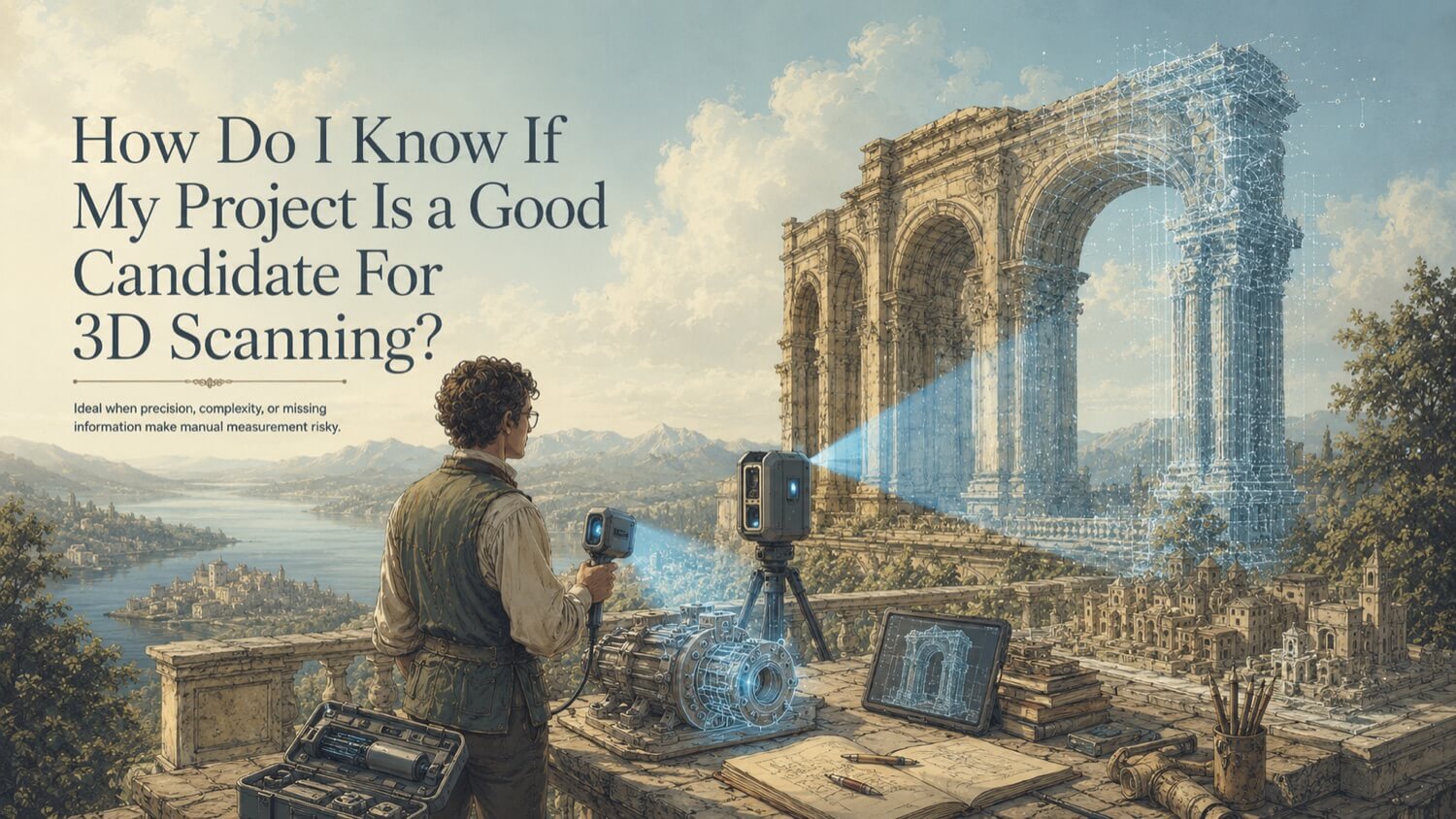
3D laser scanning is not the correct solution for each scoped project. It delivers outsized value in specific circumstances , and adds unnecessary cost in others. The five-question qualification checklist below helps engineering managers, plant directors, and procurement teams evaluate whether their project warrants a scanning investment before requesting a formal proposal.
GDS Project Support
Most physical-to-digital projects touch more than one discipline. Depending on the scope, GDS can support the workflow from field capture through usable engineering deliverables with 3D Laser Scanning, 3D Modeling, reverse engineering, and Consulting.
GDS lists office locations in Torrance, California and Houston, Texas, and posted service coverage across major metros including Houston, Dallas, San Antonio, Austin, Los Angeles, San Diego, San Jose, Long Beach, Fort Worth, Irvine, Riverside, New Orleans, Baton Rouge, Shreveport, Las Vegas, and Beverly Hills. Confirm the current posted coverage on the GDS locations page.
Scope note: Accuracy, tolerance, deliverable format, registration method, pricing structure, schedule, access conditions, safety requirements, and any certification or compliance needs should be defined in the quote, proposal, or statement of work. This article is educational and should not be treated as a project guarantee.
The Five-Question Qualification Checklist
Answer each question honestly. Three or more "yes" answers indicate a strong scanning candidate.
Question 1: Are existing drawings unavailable, unreliable, or out of date? If the drawings for the existing facility or component predate the last significant modification , or if they never existed , any engineering work based on those drawings carries clash risk. Scanning eliminates drawing-based assumption with measured physical truth. ✔ Strong scanning indicator.
Question 2: Is physical access to the asset difficult, hazardous, or time-limited? Conventional measurement requires personnel to physically contact or closely approach every measured surface. Scanning captures millions of measurements per second from a safe standoff distance, requires fewer personnel-hours in hazardous zones, and can document a complete environment during a scheduled shutdown window that manual measurement could not complete. ✔ Strong scanning indicator.
Question 3: Does the project involve connecting new construction or equipment to existing infrastructure? Tie-in design based on inaccurate or missing drawings is the single largest cause of industrial construction rework. Scanning the existing tie-in geometry before design begins eliminates the dimensional assumption that produces field clashes. ✔ Strong scanning indicator.
Question 4: Does a component need to be replicated without original drawings? If a physical component is the only source of geometric truth , no OEM, no drawings, worn sample only , reverse engineering through 3D scanning is the only process capable of recovering an accurate, manufacturing-ready CAD model from the physical evidence. ✔ Strong scanning indicator.
Question 5: Has previous rework on similar projects been caused by inaccurate dimensional information? If the project type has historically produced field clashes, remeasurement visits, or fabrication errors attributable to dimensional inaccuracy, scanning the physical conditions before design begins directly addresses the root cause. ✔ Strong scanning indicator.
Strong Candidate Indicators
Projects that consistently deliver high scanning ROI share these characteristics:
| Indicator | Why Scanning Delivers Value |
|---|---|
| Brownfield tie-in design | Scan replaces unknown existing conditions with measured reality |
| Spool prefabrication and modular construction | Exact tie-in geometry enables off-site fabrication with field-ready fit |
| Obsolete component replacement, no OEM | Physical part is the only available reference |
| High-value equipment or pipeline | Cost of rework exceeds scanning investment by 10 to 50× |
| Safety-critical dimensional verification | Traceable accuracy documentation required for regulatory compliance |
| Multiple future projects anticipated | One scan program eliminates remobilization costs for subsequent projects |
Projects Where Scanning May Not Be the Right Tool
Scanning should be matched to the use case and deliverable need:
- New greenfield construction with complete, current design drawings: Scanning is a documentation tool; it does not add engineering value where drawings accurately represent what exists.
- Simple, accessible, single-feature measurement: A single pipe diameter or wall thickness measured once with a caliper does not justify scanner mobilization.
- Geometry that exceeds scanner capability: Fully enclosed internal passages, submerged surfaces, and features inside sealed vessels cannot be captured by optical scanners. (CT scanning or ultrasonic testing may be appropriate alternatives.)
- Extremely tight budget with low rework risk: For minor modifications in well-documented, stable facilities, the scanning investment may exceed the risk-adjusted value of the dimensional accuracy it provides.
GDS will tell you honestly if scanning is not the right approach for your project. Our business model is based on repeat client relationships, not one-time transactions.
The ROI Case for Scanning
Industrial project economics often support scanning investment when rework risk is present, but the business case should be evaluated against project-specific costs:
| Metric | Typical Value |
|---|---|
| Potential cost exposure from one field rework event | project-specific and often significant |
| Average scanning cost for a tie-in zone survey | project-specific based on scope and deliverables |
| Field rework reduction rate (scan vs. no scan) | measurable reduction |
| Break-even point | Often depends on avoiding even one meaningful field rework event |
A single avoided piping clash can materially offset the scanning investment. For facilities with multiple tie-in points or high-consequence systems, the ROI case should be evaluated carefully during scoping.
Quick Facts
Continue Reading
The next best article depends on where you are in the project. These suggested reads connect this topic to the next practical decision your team is likely to face.
FAQ
How do I know if 3D scanning will save money on my project?
The key question is: what is the cost of a dimensional error on this project? If a single field rework event costs more than the scanning investment, scanning has a clearer ROI case. For many industrial tie-in and brownfield renovation projects, scan data can help reduce dimensional-error risk, but ROI should be evaluated against the specific project cost of rework and the required deliverable scope.
Can GDS help me determine if my project is a scanning candidate?
Yes. GDS can review your project information and help determine whether scanning is the right measurement strategy. Share your project description, facility type, and engineering objective, and the GDS project team will advise whether scanning is the right approach , or whether a different measurement strategy is more appropriate.
What if my facility has no existing drawings at all?
A facility with no existing drawings is one of the strongest scanning candidates. Without scan data, every design decision about new equipment, new piping, and structural modifications is based on physical measurement assumptions that carry clash risk. Scanning establishes the geometric baseline the engineering team needs to work confidently.
Not Sure If Scanning Is Right for Your Project?
Share your project description with GDS , our engineers will give you an honest assessment of whether 3D scanning delivers value for your specific situation, at no charge.