
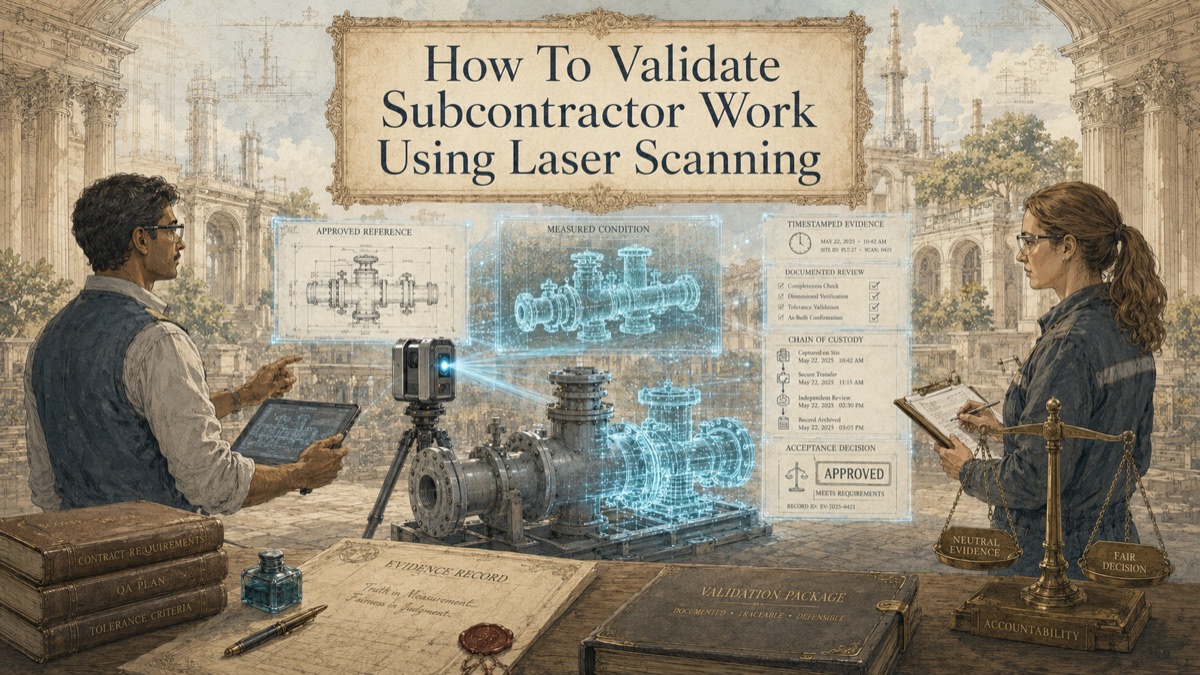
A prime contractor receives a subcontractor data book for a fabricated package. The paperwork looks complete. The shop says the work is ready. The schedule says the package must be accepted this week.
Then the field team raises a concern: the last package from this subcontractor did not fit without rework.
At that moment, the prime does not need another opinion. It needs a controlled way to compare the subcontractor's work against the approved requirement and document the result.
Laser scanning can help by creating measurable evidence. But evidence is only useful when the validation process is defined before the disagreement begins.
The Problem With Subjective Subcontractor Sign-Off
Subcontractor validation often breaks down because each party sees the same work through a different lens. The subcontractor sees completion. The prime contractor sees interface risk. The owner sees compliance risk. The field team sees installation consequences.
Without a neutral measurement record, the discussion can turn into a debate about photos, tape checks, field notes, and memories of what was agreed.
A scan-based validation workflow changes the conversation. It creates a measured record of visible geometry at a known time, compared against an approved reference or defined criteria. That does not automatically decide the contract outcome, but it gives the responsible parties stronger evidence for review.
Inspection Evidence Is Different From Acceptance
Inspection asks: What was measured, and how does it compare to the reference?
Acceptance asks: Does the responsible authority accept the work under the contract and project procedure?
Those are related, but they are not the same. GDS can support the inspection evidence through capture, processing, comparison, and reporting when scoped. The owner, prime contractor, engineer, QA manager, or other authorized party should make the formal acceptance, rejection, concession, or rework decision.
This distinction protects the project because it keeps measurement evidence from being confused with contractual authority.
The Subcontractor Validation Framework
Step 1 - Define the Requirement Before Award
The strongest validation process starts in the subcontract. The scope should define what will be scanned, when scanning occurs, what reference controls the comparison, what tolerance or review criteria apply, who receives the data, and who has authority to accept or disposition findings.
Trying to add scan-based acceptance after a dispute begins can still help technically, but it is less clean contractually.
Step 2 - Establish Hold and Witness Points
A hold point means the subcontractor should not proceed beyond a defined stage until the validation step is completed and reviewed under the project procedure.
A witness point means the owner or prime has the right to observe or review the validation step, but work may proceed according to the agreed notice procedure if attendance is waived.
The right choice depends on the consequence of covering, shipping, embedding, or installing the work before verification.
Step 3 - Capture the Work at the Right Time
The scan should happen while critical geometry is still visible. Surface treatment, insulation, fireproofing, concrete encasement, cladding, and equipment installation can hide the exact features that later matter.
The capture plan should identify access, lighting, staging, safety constraints, surface conditions, exclusions, and any areas the subcontractor must clear before scanning.
Step 4 - Preserve the Evidence Package
A validation package should preserve more than the final PDF. Depending on the scope, it may include raw scan files, registered point cloud, processing notes, reference model revision, alignment method, report, finding log, and file checksums.
This does not mean every stakeholder needs every file. It means the evidence trail should be clear enough that the result can be reviewed later if a question arises.
Step 5 - Review Findings and Close the Record
Findings should be handled through the approved quality or contract process. Some items may become NCRs. Some may become observations. Some may require engineering disposition. Some may be accepted with documented concession.
The final sign-off package should identify the report revision, finding status, concessions, rework evidence, supplemental scans, and final review status.
Ownership, Access, and Chain of Custody
Data ownership and access should be stated in the contract or project procedure. It is risky to assume that the party paying for the scan automatically controls every downstream use, or that the subcontractor automatically owns measurement data captured on their work.
A practical approach is to define:
| Topic | What to Define |
|---|---|
| Data custody | Who stores the raw scan, registered point cloud, report, and reference files |
| Access rights | Which parties may view, download, or interrogate the data |
| Authorized use | Whether the data may be used for QA, dispute review, future work, or only the current package |
| Revision control | How updated models, new reports, concessions, and rework scans are recorded |
| Confidentiality | How proprietary subcontractor, owner, or facility information is protected |
These items are not just administrative. They determine whether the data will help resolve problems or create new ones.
Using Point Clouds in Disputes Without Overstating Them
A registered point cloud can be powerful evidence because it records visible geometry at a documented time. It can often be reviewed by multiple parties using common point-cloud tools.
But it should not be described as impossible to dispute. Processing choices, alignment methods, coverage limitations, reference revisions, and interpretation all matter. A strong evidence package makes those items visible.
When a dimensional dispute occurs, a fair process may include:
1. Freeze the disputed work condition where practical. 2. Identify the reference revision and inspection criteria. 3. Review the raw and registered data package. 4. Compare processing or alignment methods if parties disagree. 5. Use a third-party reviewer or supplemental scan when the project procedure requires it. 6. Document the final disposition under the contract.
The scan does not eliminate project governance. It gives governance better evidence.
Interactive Project Readiness Check
Select the items your team has already defined. This planning aid does not determine technical acceptance or replace project scoping.
Quick Facts
Continue Reading
The next best article depends on where you are in the project. These suggested reads connect this topic to the next practical decision your team is likely to face.
Frequently Asked Questions
Should scan-based validation be written into the subcontract?
Yes, when the project intends to rely on scan-based validation. The subcontract or project procedure should define timing, reference data, review criteria, access, deliverables, and acceptance authority.
Who owns the point cloud from subcontractor validation?
Ownership and access should be defined in the contract or project procedure. The important point is to establish custody, authorized use, confidentiality, and retention before the scan is performed.
Can a subcontractor provide their own scan report?
It may be acceptable if the contract permits it and the methodology, raw data access, reference control, review rights, and report format meet the owner's or prime contractor's requirements.
Does a point cloud settle a dimensional dispute automatically?
No. A point cloud provides measured evidence. Disputes still require review of reference data, alignment method, coverage, criteria, and the contract or quality procedure.
Connect this article to the right GDS workflow
Most physical-to-digital projects touch more than one service. GDS can help determine whether the right starting point is 3D laser scanning, 3D modeling, reverse engineering, or consulting before scope, pricing, schedule, and deliverables are finalized.
GDS provides nationwide project coverage. Current examples from the GDS locations page include Houston, Dallas, Los Angeles, and Baton Rouge.
Ready to Start?
Tell GDS about your asset, your goals, and your deliverable needs. GDS can scope the right scanning, modeling, and reporting for your project.