

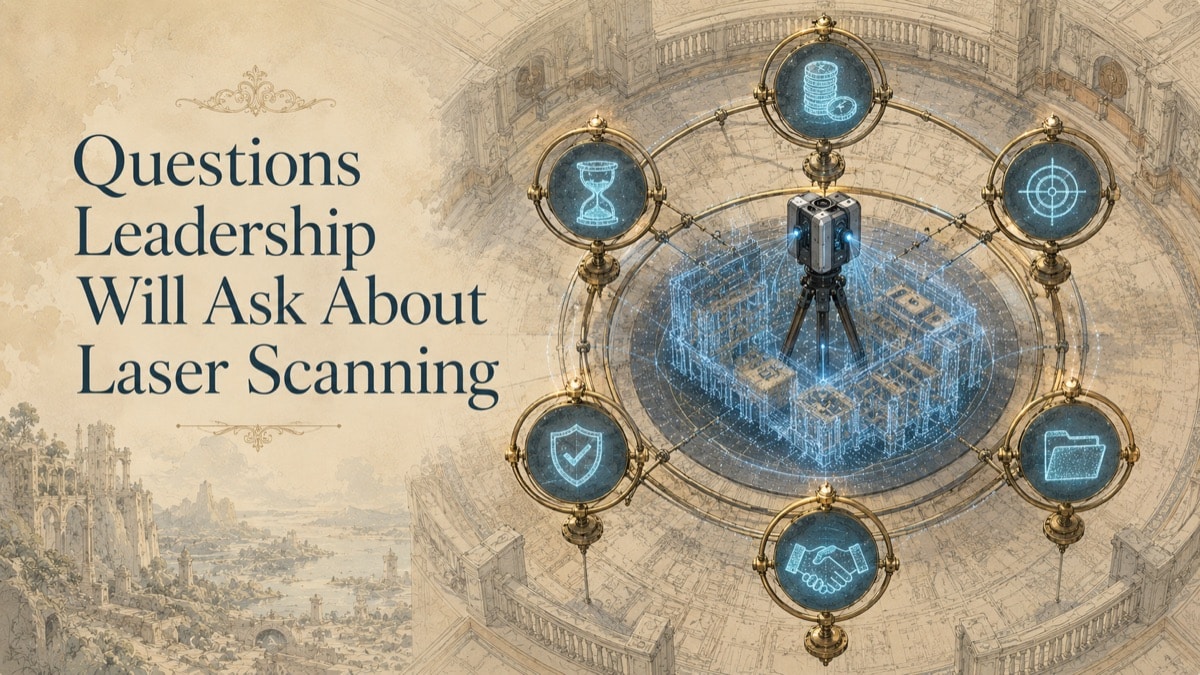
A project champion walks into a leadership meeting believing the technical case is obvious. Then the first question is not about point density or scanner type. It is: What decision does this support? Why now? What happens if we do nothing? Who will use the data? What exactly are we buying? A champion who cannot answer those questions risks losing approval before the technical value is understood.
Leadership questions are predictable. Preparing answers ahead of time turns scanning from a technical request into a structured decision: scope, value, risk, deliverables, timing, ownership, and next step.
Key Takeaway
A project champion should be ready to explain the decision, timing, information risk, exact scope, usable deliverables, limitations, responsible reviewers, and what happens if the organization does nothing or chooses another method.
The Approval Meeting Problem
This is why GDS treats scanning as a decision-support workflow, not just a technical field activity. The question is not simply, “Can we scan it?” The more useful question is, “What decision must the data support, and what evidence will make that decision safer?”
Why This Matters Before Approval
Laser scanning is easiest to approve when the request is connected to a decision. A scan may support planning, design, procurement, operations, ownership, construction, inspection, or long-term asset management. The same field capture can produce very different outcomes depending on whether the team needs a registered point cloud, a model, drawings, a report, a fit-check, or consulting support.
The approval case should also state what the scan will not do. It does not automatically certify code compliance, prove concealed conditions, replace engineering judgment, or guarantee a project outcome. It provides measured visible-condition evidence and selected derivatives when the scope, access, and deliverables are defined correctly.
The Leadership Question Preparation Framework
Phase 1 - Decision
What decision will the scan support and who owns that decision?
Phase 2 - Risk
What uncertainty exists today and what could happen if the project proceeds without measuring it?
Phase 3 - Scope
What area, object, system, or interface will be captured, and what is excluded?
Phase 4 - Deliverable
What will the team receive and how will they use it?
Phase 5 - Governance
Who owns the files, approves reliance, and keeps the record current after delivery?
Questions About Cost
Leadership will ask whether scanning is budgeted, why it is needed now, what the alternative costs, and whether the scope can be reduced. Answer by tying cost to decision risk and by defining a bounded scope.
Questions About Timing
Expect questions about schedule impact, site access, turnaround, and whether scanning will slow the project. Explain when the data is needed, what decisions depend on it, and what work can proceed in parallel.
Questions About Usefulness
Leaders will want to know who uses the point cloud, model, drawings, or report. A good answer identifies the stakeholder and the decision, not just the file format.
Questions About Risk and Limits
Credible answers include limitations. State what the scan captures, what it does not capture, and which decisions remain with engineering, operations, ownership, or procurement.
Decision Matrix: What to Show the Audience
| Issue | Why It Matters | Practical Response |
|---|---|---|
| Why now? | The project is approaching a decision point where existing-condition uncertainty matters. | Decision date and project milestone |
| What do we get? | A defined deliverable such as a point cloud, drawings, model, report, or scope plan. | Quote deliverables and sample output |
| Who uses it? | Engineering, operations, procurement, ownership, or construction depending on scope. | Stakeholder list |
| What if we do nothing? | The team proceeds from current information and accepts associated uncertainty. | Risk summary |
| How do we control scope? | Define area, deliverables, exclusions, and acceptance review before mobilization. | SOW or proposal |
Table accessibility note: The table uses a plain-text header row and describes each issue, its consequence, and the practical response without relying on color.
Practical Talking Points and Decision Criteria
Use simple language when explaining scanning internally:
- We are not buying technology for its own sake; we are buying better information for a defined decision.
- The value depends on scope, access, coordinate control, deliverable format, and how the team will use the data.
- Existing drawings, photos, and site walks may still be useful, but they may not be sufficient for decision-critical geometry.
- The output should be matched to the audience: management needs the decision case, procurement needs comparable scope, engineering needs model status, operations needs an access plan, and ownership needs a maintainable record.
- Any accuracy, tolerance, schedule, acceptance, or certification language should come from the quote, proposal, inspection plan, purchase order, or statement of work.
Common Misconceptions
“Leadership will ask only about cost.”
Cost matters, but leadership also asks about purpose, usefulness, timing, risk, and accountability.
“We should avoid limitations.”
Limitations build credibility. They show the team understands what the scan can and cannot support.
“One answer fits every audience.”
Leadership, procurement, engineering, operations, and ownership each need a different emphasis.
Leadership Question Drill
Choose a leadership question. Use the response prompt to prepare project-specific evidence rather than relying on generic sales claims.
Quick Facts
Continue Reading
The next best article depends on where you are in the project. These suggested reads connect this topic to the next practical decision your team is likely to face.
Frequently Asked Questions
What is the first leadership question to prepare for?
Prepare to answer what decision the scan supports and why current information is not enough for that decision.
How should I explain what we are buying?
Describe the deliverable and its use: point cloud, drawing, model, deviation report, fit-check, or consulting scope.
What should I say if leadership asks about accuracy?
Say accuracy is project-specific and should be defined by the required decision, capture method, control, registration, and verification plan.
How do I answer “What happens if we wait?”
Explain which decisions will proceed without measured evidence and what risk late discovery creates.
Should I bring examples?
Yes. A simple visual example, sample deliverable, and one-page decision brief are usually more effective than a technical deck alone.
Connect this article to the right GDS workflow
Most physical-to-digital projects touch more than one service. GDS can help determine whether the right starting point is 3D laser scanning, 3D modeling, reverse engineering, or consulting before scope, pricing, schedule, and deliverables are finalized.
GDS supports projects nationwide. Examples from the current locations page include New Orleans, Baton Rouge, Shreveport, and Houston.
Ready to Start?
Tell GDS about your asset, your goals, and your deliverable needs. GDS can scope the right scanning, modeling, and reporting for your project.