
Someone inside an organization often recognizes the need for better existing-condition information before everyone else does. That person may be an engineer trying to reduce design uncertainty, an operations leader planning a shutdown, a procurement professional comparing proposals, an owner protecting a capital investment, or a project manager preparing for a difficult approval meeting.
The challenge is not always understanding the technical value of 3D laser scanning. The challenge is communicating that value clearly to people who have different priorities, different levels of technical knowledge, and different responsibilities for cost, schedule, risk, safety, and project outcomes.
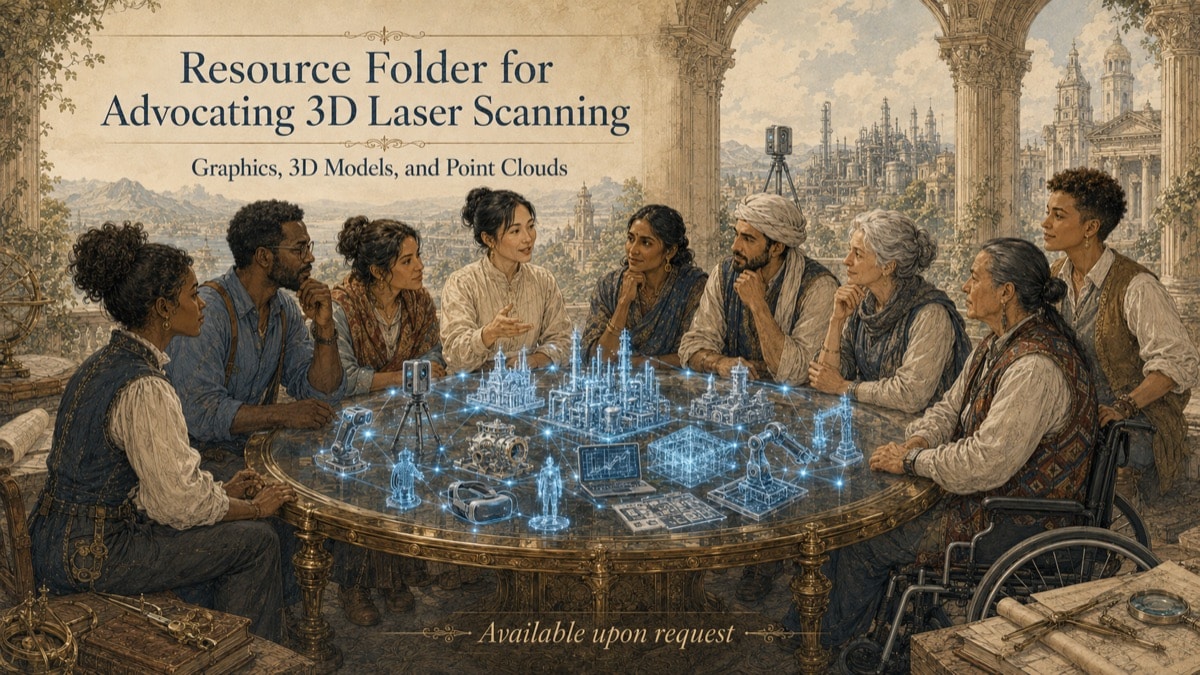
The GDS Resource Folder for Advocating 3D Laser Scanning is designed to help bridge that gap. It brings together selected graphics, 3D model examples, point-cloud visuals, sample deliverable views, and practical decision resources that can help a serious project champion explain what scanning is, what it may support, what the team may receive, and why measured information can matter before a decision becomes difficult or expensive to change.
Available upon request. Access is provided only after a brief 15-minute consultation with GDS.
Key Takeaway
The advocacy folder is curated after a short consultation so examples match the audience, decision, and project type. Its contents are educational and illustrative, not project-specific estimates, certified measurements, engineering documents, or guaranteed deliverables.
Why This Resource Folder Exists
Laser scanning is easy to describe poorly. A project champion may focus on the scanner, millions of points, accuracy terminology, or an impressive image without explaining the decision the data needs to support. That approach can make scanning sound like a technology purchase instead of a method for improving information quality.
The resource folder is intended to help advocates communicate the practical case. A strong explanation connects the current information gap to a defined decision. It identifies the area or object that needs to be captured, the people who will use the information, the deliverable they require, and the consequences of proceeding with incomplete or unreliable conditions.
Graphics and examples can make those relationships easier to understand. A leader may respond to a clear risk-and-value illustration. An engineer may need to see the difference between a point cloud, mesh, CAD model, and BIM deliverable. Procurement may need an apples-to-apples scope comparison. Operations may care most about access, disruption, safety, and future reuse. Ownership may focus on long-term asset knowledge and capital planning.
The folder helps a project champion select the right visual language for the right audience.
What the Resource Folder May Include
The contents are curated for the request and may include:
- Presentation-ready graphics explaining scanning workflows, project risk, deliverables, or stakeholder value
- Selected 3D model examples showing CAD, BIM, mesh, reverse-engineered, or digital-twin concepts
- Point-cloud images or representative datasets that demonstrate visible-condition capture and spatial context
- Sample deliverable views, sections, comparisons, fit-checks, or coordination concepts
- Leadership, procurement, engineering, operations, and ownership talking points
- Checklists for defining purpose, scope, access, coordinate basis, model status, and intended use
- Links to relevant GDS articles for deeper explanation and internal review
Not every requester needs every item. In many cases, a smaller and more focused package is more persuasive than a large folder without explanation. GDS may therefore provide the materials most relevant to the stated audience and decision rather than automatically releasing every available resource.
Why Context Matters More Than a Collection of Files
A point cloud can be visually impressive and still be the wrong deliverable for the decision. A 3D model can look complete while containing inferred geometry, simplified systems, or conditions that were not visible during capture. A graphic can explain a general benefit without proving a project-specific return. A sample from one industry may not accurately represent another facility, component, site, or scope.
For that reason, GDS does not treat the resource folder as an unrestricted public download. The materials are more useful when the requester understands what each example represents, how it may be presented, and what it does not establish.
This protects the requester as well as GDS. It reduces the risk that an illustrative model is presented as a guaranteed deliverable, that a point-cloud example is used to imply an unsupported accuracy level, or that a general business graphic is treated as a project-specific cost estimate.
The goal is informed advocacy, not advocacy built on another assumption.
Why We Begin With a 15-Minute Consultation
Before providing access, GDS asks for a brief 15-minute consultation. This is not intended to create unnecessary friction, require a lengthy presentation, or pressure someone into purchasing services. It is a respectful way to understand what the requester is trying to accomplish and whether the materials are appropriate for the situation.
The conversation helps confirm that the request is connected to a genuine and reasonably serious business, engineering, operations, ownership, procurement, construction, educational, or planning need. It also helps GDS understand who the intended audience is, what decision is approaching, and which resources are most likely to help.
Serious does not necessarily mean that a project is already funded or ready to mobilize. It means there is a real question, a legitimate use, an identifiable audience, and a willingness to discuss the context honestly. Early-stage planning requests are welcome when the requester can explain the problem they are trying to solve.
What We Discuss During the Consultation
The 15-minute conversation is focused and practical. We will generally ask:
- What are you trying to scan, document, verify, model, inspect, or explain?
- What decision or approval are you preparing for?
- Who needs to understand or approve the request?
- What information is available today, and why may it be insufficient?
- Which examples would be most useful: graphics, models, point clouds, reports, or stakeholder talking points?
- How do you intend to use or share the materials?
- Is there a realistic project stage, planning window, or decision timeline?
These questions allow GDS to determine whether the request is appropriate and to assemble a more useful package. If another resource, article, or service would be a better fit, we will say so directly.
Who This Resource Is Designed to Help
The folder is designed for people who are doing the work of building understanding inside an organization. That may include:
- Engineers explaining why current geometry should be verified before design is committed
- Project managers preparing a business case or leadership briefing
- Operations teams planning access, shutdowns, maintenance, or future modifications
- Procurement teams trying to compare scanning proposals fairly
- Owners evaluating long-term asset information and capital planning value
- Construction and fabrication teams trying to reduce field discovery and fit risk
- Educators, researchers, and technology leaders presenting responsible physical-to-digital workflows
The common requirement is a legitimate need to communicate clearly and responsibly.
Responsible Use and Important Limitations
The resource folder is educational and illustrative. Unless expressly stated in writing, its contents are not project-specific deliverables, certified measurements, engineering documents, survey products, inspection records, or guarantees of accuracy, savings, schedule, completeness, or outcome.
Any sample point clouds, models, drawings, reports, or graphics should be presented with their original context intact. Materials should not be altered to imply GDS endorsement of an unrelated claim, represented as work completed for the requester's project, resold, or used as a substitute for professional review.
Project-specific accuracy, tolerance, coordinate control, registration, file formats, level of detail, model status, access, schedule, acceptance criteria, and review responsibility must be defined in the applicable quote, proposal, statement of work, purchase order, or inspection plan.
Request Access to the Resource Folder
If you are preparing a serious conversation about 3D laser scanning, GDS welcomes the opportunity to understand what you are trying to accomplish.
Request the resource folder and briefly describe your organization, intended audience, decision, project stage, and the types of materials that would be most useful. We will then coordinate a focused 15-minute consultation. After the consultation, GDS will determine the appropriate resources to provide based on the request and intended use.
The process is intentionally short, personal, and practical. The objective is to help you communicate the value of better measured information with greater clarity and credibility.
Available upon request.
Advocacy Resource Request Builder
Select the audience and the decision you need to support. The result helps focus the 15-minute consultation and the materials provided afterward.
Quick Facts
Continue Reading
The next best article depends on where you are in the project. These suggested reads connect this topic to the next practical decision your team is likely to face.
Frequently Asked Questions
What is included in the 3D laser scanning advocacy resource folder?
The folder may include curated graphics, selected 3D model examples, point-cloud visuals, sample deliverable views, decision checklists, and stakeholder-specific talking points. Contents are selected for the request and may vary.
Why is a 15-minute consultation required?
The brief consultation helps GDS understand the audience, decision, intended use, and seriousness of the request. It allows GDS to provide relevant materials with the correct context instead of releasing a large, unexplained collection of files.
Does a request need to be a funded project?
No. Early-stage planning and educational requests may be appropriate. The request should be genuine, connected to an identifiable need or audience, and supported by a willingness to discuss how the materials will be used.
Is the consultation a sales presentation?
No. It is intended to be a focused 15-minute conversation about the request. If GDS services may be relevant, that can be discussed separately and transparently.
Will every requester receive the entire folder?
Not necessarily. GDS may provide a focused selection based on the audience, decision, project stage, intended use, and appropriateness of the request.
Can the sample models or point clouds be used for design or construction?
No, unless a specific file is expressly issued for that purpose under a written project agreement. General resource-folder materials are illustrative and should not be relied upon as project-specific measurements or engineering deliverables.
Connect this article to the right GDS workflow
Most physical-to-digital projects touch more than one service. GDS can help determine whether the right starting point is 3D laser scanning, 3D modeling, reverse engineering, or consulting before scope, pricing, schedule, and deliverables are finalized.
GDS supports projects nationwide. Examples from the current locations page include San Diego, San Jose, Las Vegas, and Los Angeles.
Request Access
Schedule the brief 15-minute consultation so GDS can understand your audience, decision, and intended use before providing the appropriate advocacy resources.