
You know a laser scanning project would solve the problem. You have seen what the data looks like, you understand the accuracy it delivers, and you can picture exactly how it would support the engineering scope your team is trying to execute. The challenge is that the person controlling the budget has not seen what you have seen , and "trust me, the scan data is incredible" is not a capital expenditure justification.
Building internal support for a scanning project is a communication and framing challenge as much as a technical one. This article gives you the structure, the language, and the strategy to move from "I think we should do this" to a signed purchase order.
Understand Who You Are Selling To
Before you build the case, identify the specific stakeholders who need to approve or support the investment. They are not all the same, and they do not respond to the same arguments.
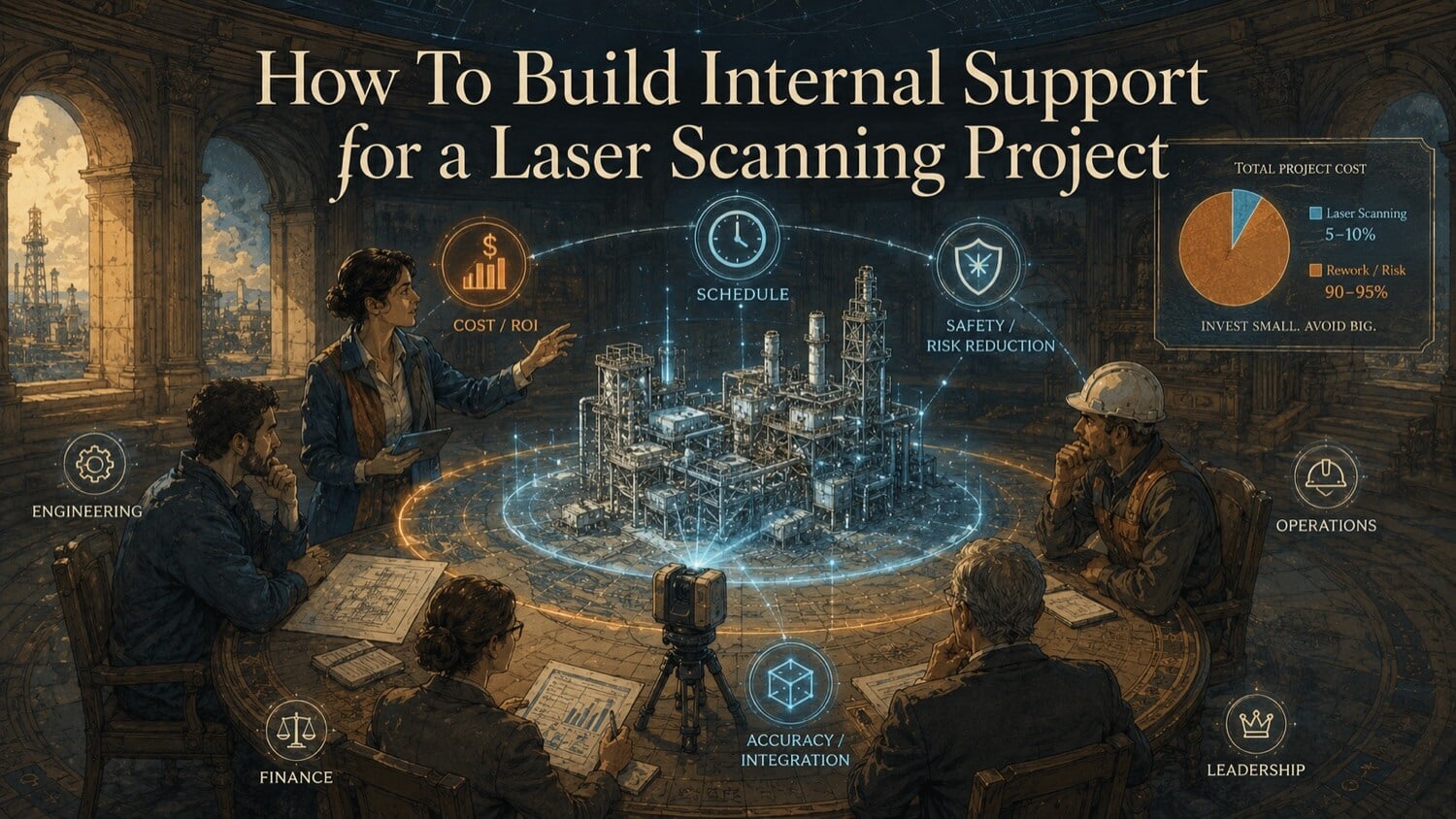
Finance and budget holders respond to numbers. They want to see the cost of the scan compared to the cost of the problem it prevents. They are comfortable with ROI calculations, cost avoidance framing, and budget-versus-actual comparisons from analogous projects. Lead with quantified cost reduction.
Engineering leadership responds to technical credibility and risk. They want to understand accuracy, coverage, and deliverable format. They want to know the technology works, that GDS has done this type of project before, and that the data will integrate into the engineering workflow. Lead with capability and demonstrated project references.
Operations and maintenance leadership responds to downtime and disruption. They want to know how long the scanning crew will be on site, what areas will be affected, what access is required, and what the disruption to running operations will be. Lead with access planning, operational coordination, site preparation requirements, and expected field impact.
Senior management responds to strategic framing. They want to understand how scanning connects to the organization's broader objectives , cost efficiency, asset management maturity, digital transformation. They are less interested in technical detail and more interested in what this means for the programme, the asset, or the organization's capability.
Tailor your presentation to the audience in the room. A single presentation that attempts to serve all audiences simultaneously often succeeds with none of them.
Build the Financial Case First
The financial case is the foundation. Without it, other arguments are supplementary. With it, other arguments become reinforcements.
Frame the Scan Cost Against the Cost of Not Scanning
The most common framing mistake is presenting the scan as a cost. Present it instead as cost avoidance or cost reduction. The question is not "what does the scan cost?" , it is "what does the problem cost if we don't scan?"
Identify the specific scenario your team faces and attach numbers to the current-state cost:
Example: Missing as-built documentation for a planned renovation - Engineering design based on unreliable drawings: risk of late design changes estimated at X% of engineering budget - Contractor RFIs and site queries due to drawing inaccuracies: average X hours per RFI at engineering day rate - Potential rework if fabricated components don't fit: contractor estimate for worst-case rework scenario
Against these numbers, the scan cost can be evaluated against the specific problem cost it is intended to reduce or avoid.
Example: Fabrication project without scan data - One trial-fit visit to verify fabricated components: site mobilization + downtime cost - One rework cycle if components don't fit: fabrication cost + remobilization + extended shutdown - Total risk exposure without scanning: [quantify from your organization's actual rework history]
Most organizations have recent examples of rework or fit-up failures that were expensive. These are your most powerful data points , not industry averages, but your own documented costs.
Quantify the Schedule Benefit
Scan data eliminates return site visits and reduces RFI cycles. In industries where plant access requires a permit-to-work, scaffolding, or production shutdown, the cost of a single unplanned return visit is substantial. Quantify the value of eliminating even one unplanned site visit:
- Mobilisation cost for an unplanned visit
- Production downtime for access preparation
- HSE permitting and preparation time
- Engineering rework to accommodate field conditions discovered during the visit
A single avoided return visit often pays for the scan multiple times over.
Address the Standard Objections
Every internal advocate for scanning encounters the same objections. Prepare specific, factual responses.
Objection: "We already have drawings." Response: Original construction drawings show design intent, not necessarily what was built. Field modifications, maintenance repairs, and undocumented changes accumulate over decades. The scan shows what is actually there , not what the original drawing says should be there. If the drawings are accurate, the scan confirms it. If they are not, it finds the discrepancies before they become field problems.
Objection: "It's too expensive." Response: Frame against the cost of the alternative. What has a single rework event cost your organization in the last three years? What does one unplanned return site visit cost, including mobilization, downtime, and associated engineering? A typical laser scanning project costs a fraction of a single mid-project rework cycle. The question is not whether scanning is affordable , it is whether the alternative is.
Objection: "We can do it with a tape measure and a laser distance meter." Response: Manual surveys are slower, capture less data, and require return visits for missed measurements. They produce point-to-point dimensions, not a complete three-dimensional record. The scan captures everything in one mobilization , including surfaces, clearances, and spatial relationships that a manual survey would require multiple days of return visits to collect.
Objection: "We've never needed it before." Response: Ask how many RFIs or field changes on recent projects were triggered by inaccurate as-built information. Ask how many times engineering assumptions based on old drawings had to be revised during construction. The need has always existed , the technology to address it efficiently is what is new.
Use a Pilot Project to Build Proof of Concept
If the organization is not ready to commit to scanning as a standard practice, propose a pilot project. A well-chosen pilot is the strongest internal advocacy tool available because it produces tangible, organization-specific evidence rather than vendor claims or industry statistics.
Select the right pilot scope. Choose a project where: - There is a specific, measurable problem that scanning will address (missing drawings, fabrication fit-up risk, facility modification planning) - The scan can be completed and deliverables received within a timeframe that keeps the pilot visible to stakeholders - The results can be compared against a before-state baseline (existing drawings, manual survey dimensions, or a previous project's rework history)
Define success metrics before the pilot begins. Agree with stakeholders on what the pilot will demonstrate and how success will be measured. Examples: - "The scan scope is intended to support as-built drawings with defined verification requirements" - "The scan data may reduce the need for a return site visit when coverage and resolution support the decision" - "Fabricated pipe spools produced from scan data will fit first time on installation"
Document the results. After the pilot, produce a one-page internal case study showing: what the problem was, what the scan cost, what the deliverable achieved, and what cost or risk was avoided. This document becomes the institutional proof of concept for every subsequent scanning investment discussion.
Bring GDS into the Conversation
For significant scanning investments , particularly first projects within an organization or programme-level commitments , GDS is available to participate in internal briefings, provide facility-specific project references, and develop a project-specific business case with estimated cost avoidance figures.
A GDS technical representative can answer engineering leadership's questions directly, provide facility-type analogues from completed projects, and address the specific concerns your team has raised that are specific to your facility type, industry, or access constraints.
Request a consultation at GDS's scheduling link , these conversations are complimentary and can be conducted virtually or on site.
Quick Facts
Continue Reading
The next best article depends on where you are in the project. These suggested reads connect this topic to the next practical decision your team is likely to face.
FAQ
How do I calculate ROI for a laser scanning project?
The most defensible ROI calculation compares the scan cost against the cost of the specific problem it prevents , not a generic industry figure. Identify the risk scenario (rework, return visit, design revision, fabrication failure) and attach your organization's actual cost data. A defensible ROI model compares the scan cost against a specific avoided risk scenario using your organization's own cost history, probability assumptions, schedule impact, and reuse potential. ROI should be presented as an estimate, not a guaranteed outcome.
What is the best first project to use for a scanning pilot?
The best pilot project has a specific, measurable problem that scanning directly solves, a clear before-state baseline to compare against, and a timeframe short enough to maintain stakeholder visibility. Facility renovation projects (where existing drawings are known to be inaccurate), planned fabrication scope (where fit-up risk is explicit), and areas where a recent rework event created organizational memory of the problem all make strong pilot candidates.
Can GDS help prepare the internal business case?
Yes. GDS can provide project-specific cost avoidance estimates, analogous project references from similar facilities or industries, and a structured business case framework tailored to your organization's approval process. Contact GDS to schedule a consultation. Downloadable advocacy templates and resources are also available at the GDS Resource Library in Article 94.
How long does it typically take to get internal approval for a scanning project?
Approval timelines vary significantly by organization and project value. For projects within an engineering manager's approval authority, decisions can be made in days. For capital expenditure requiring finance or senior management approval, allow two to eight weeks for the review and approval cycle. Building the financial case and addressing objections before the formal submission reduces that timeline significantly. A concise business case with quantified assumptions is often easier for non-technical stakeholders to review than a detailed technical proposal alone.
Connect this resource to the right GDS workflow
These resource pages are intended to help teams make better planning decisions before a scope is finalized. GDS can help confirm whether the work should start with 3D laser scanning, continue into 3D modeling, require reverse engineering, or benefit from early consulting before budget, schedule, and deliverables are locked in.
GDS lists nationwide service coverage on its locations page, including posted major metropolitan areas such as Houston, Dallas, San Antonio, Austin, Los Angeles, San Diego, San Jose, Long Beach, Fort Worth, Irvine, Riverside, New Orleans, Baton Rouge, Shreveport, Las Vegas, and Beverly Hills.