
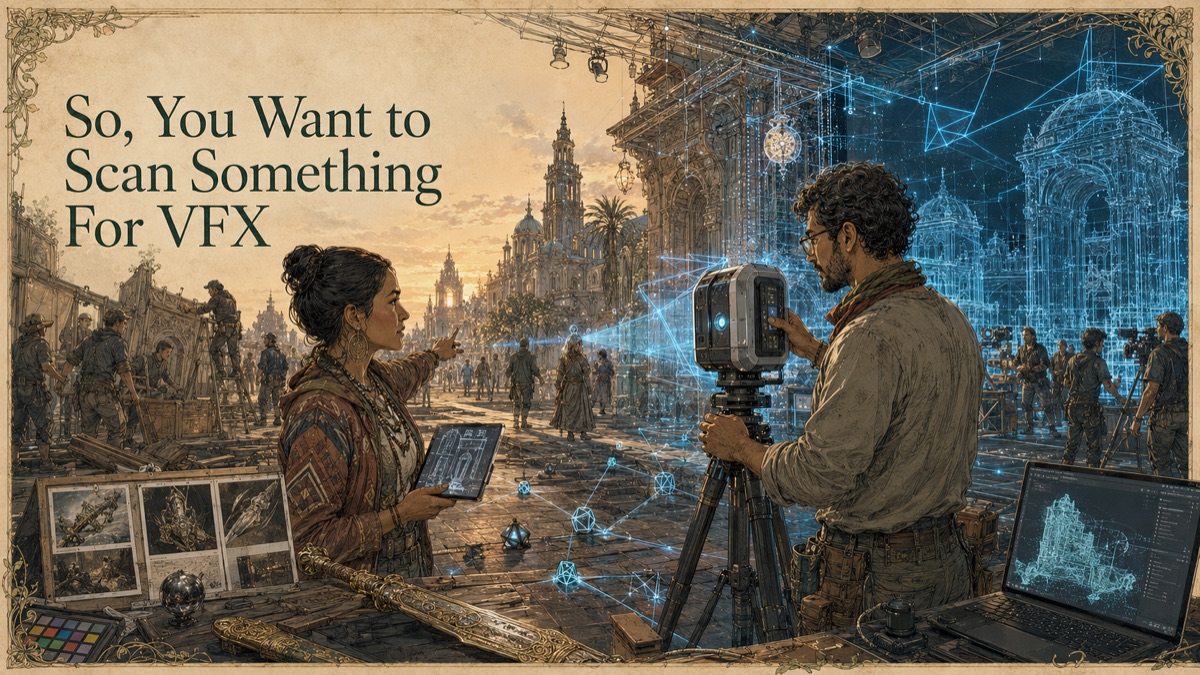
The set is available for a few hours. By tomorrow it will be dressed differently, struck, moved, or covered by the next unit. The VFX team needs scale, witness geometry, textures, hero assets, and off-frame context that may never be available again. Capturing only the obvious subject can leave matchmove, shadows, reflections, or set extensions without enough reference.
This is why GDS treats scanning as a decision-support workflow, not just a technical field activity. The question is not simply, "Can we scan it?" The more useful question is, "What decision must the data support, and what evidence will make that decision safer?"
Key Takeaway
VFX scanning should be planned around shots, cameras, set changes, lighting, hero assets, and production turnover. Define shot purpose, coordinate convention, capture state, texture needs, schedule, and downstream DCC pipeline before the set changes.
The VFX Reality-Capture Problem: The Set Changes Before the Work Begins
VFX production turns physical locations into digital evidence and creative assets. Short access windows, moving crews, reflective surfaces, lighting changes, confidential content, and immovable deadlines all affect capture quality. The highest-value data is the data the shot department will need after access is gone.
The strongest projects separate what is known, what is measured, what is modeled, and what still requires judgment. That protects the client and the service provider because the deliverable becomes evidence with context, not an implied guarantee beyond the approved scope.
What the Scan or Data Package Should Resolve
Matchmove and compositing may need walls, floors, corners, ceilings, practical fixtures, and objects outside the final frame. Hero props may need close-range capture and texture reference. Virtual production may need optimized scene derivatives, pivots, hierarchy, levels of detail, and tested transforms.
A good article page should help the reader choose the right next step. For some projects, that may be a broad spatial baseline. For others, it may be a focused interface scan, a lightweight model, a textured asset, a deviation report, or a consulting engagement before any field capture begins.
The Seven-Phase Scan-to-VFX Workflow
Phase 1 - Break down shots and departments
Identify visible areas, camera ranges, hero assets, FX needs, matchmove references, and delivery priority.
Phase 2 - Define coordinates and formats
Confirm units, axes, origin, naming, DCC applications, and engine requirements.
Phase 3 - Plan the production window
Coordinate access, confidentiality, lighting, set state, crew movement, and strike timing.
Phase 4 - Capture geometry and references
Acquire line-of-sight coverage, imagery, scale control, and notes on movable or temporary items.
Phase 5 - Register and preserve the master
Deliver controlled point clouds and high-resolution geometry with documented gaps and capture-state notes.
Phase 6 - Create approved derivatives
Segment assets, clean noise, build proxies, retopologize where scoped, and record reconstruction decisions.
Phase 7 - Validate in the shot pipeline
Test scale, transforms, camera context, silhouettes, seams, normals, and file integrity.
Deliverable Strategy
| Deliverable Type | When It Helps | Key Control |
|---|---|---|
| Registered point cloud | Preserves measured visible conditions as source evidence | Capture date, coordinate basis, coverage, and exclusions |
| Mesh or surface asset | Supports visualization, VR, VFX, reproduction, or measured surface review | Repair status, density, texture, scale, and intended use |
| CAD / STEP / IGES | Supports engineering exchange, reverse modeling, interfaces, and downstream design | Modeled-versus-measured status and design-intent assumptions |
| Drawings / exhibits / reports | Supports stakeholder review, procurement, QA, or decision records | Revision, units, review authority, and limitations |
Table accessibility note: The header row defines each deliverable, its best-use case, and the control required before relying on it.
Use Cases
- Digital set extensions, environment reconstruction, and matchmove reference
- Virtual production, techvis, and camera planning
- Hero prop digitization and practical asset capture
- Destruction, fluids, particles, continuity records, and remote reviews
Risks and Misconceptions
Only what appears in frame may not be enough
Tracking, reflections, shadows, simulations, and camera changes may require off-frame context approved by the VFX supervisor.
A scan is not automatically a finished production asset
Measured data may need cleanup, segmentation, topology, UVs, textures, materials, hierarchy, and optimization.
Texture capture may not work under set lighting
Mixed, theatrical, moving, or directional lighting can contaminate textures. Geometry and appearance capture may need separate conditions.
Coordinate conversion can break the pipeline
Axis, handedness, origin, unit, and scale errors can propagate through layout, animation, FX, and virtual production.
Shot Requirement Selector
Select the downstream visual-effects need. The recommended capture emphasis should be confirmed with the visual-effects supervisor before the set changes.
Quick Facts
Continue Reading
The next best article depends on where you are in the project. These suggested reads connect this topic to the next practical decision your team is likely to face.
Frequently Asked Questions
How quickly can scan data be turned over to VFX?
Turnover depends on capture volume, registration, cleanup, derivative type, and QA. Priority packages can be defined around shot needs and delivered on a rolling basis.
Can GDS scan a set while production continues?
Sometimes, but movement, access, lighting, confidentiality, and safety can reduce quality.
Do VFX teams need both the point cloud and mesh?
Often yes. The point cloud preserves evidence; the mesh supports surfaces, layout, collision, and production.
Can reflective or transparent props be scanned?
They may require alternate angles, approved surface treatment, supplemental methods, or documented reconstruction.
Connect this article to the right GDS workflow
Most physical-to-digital projects touch more than one service. GDS can help determine whether the right starting point is 3D laser scanning, 3D modeling, reverse engineering, or consulting before scope, pricing, schedule, and deliverables are finalized.
GDS supports projects nationwide. Examples from the current locations page include San Diego, San Jose, Las Vegas, and Los Angeles.
Ready to Start?
Tell GDS about your asset, your goals, and your deliverable needs. GDS can scope the right scanning, modeling, and reporting for your project.