
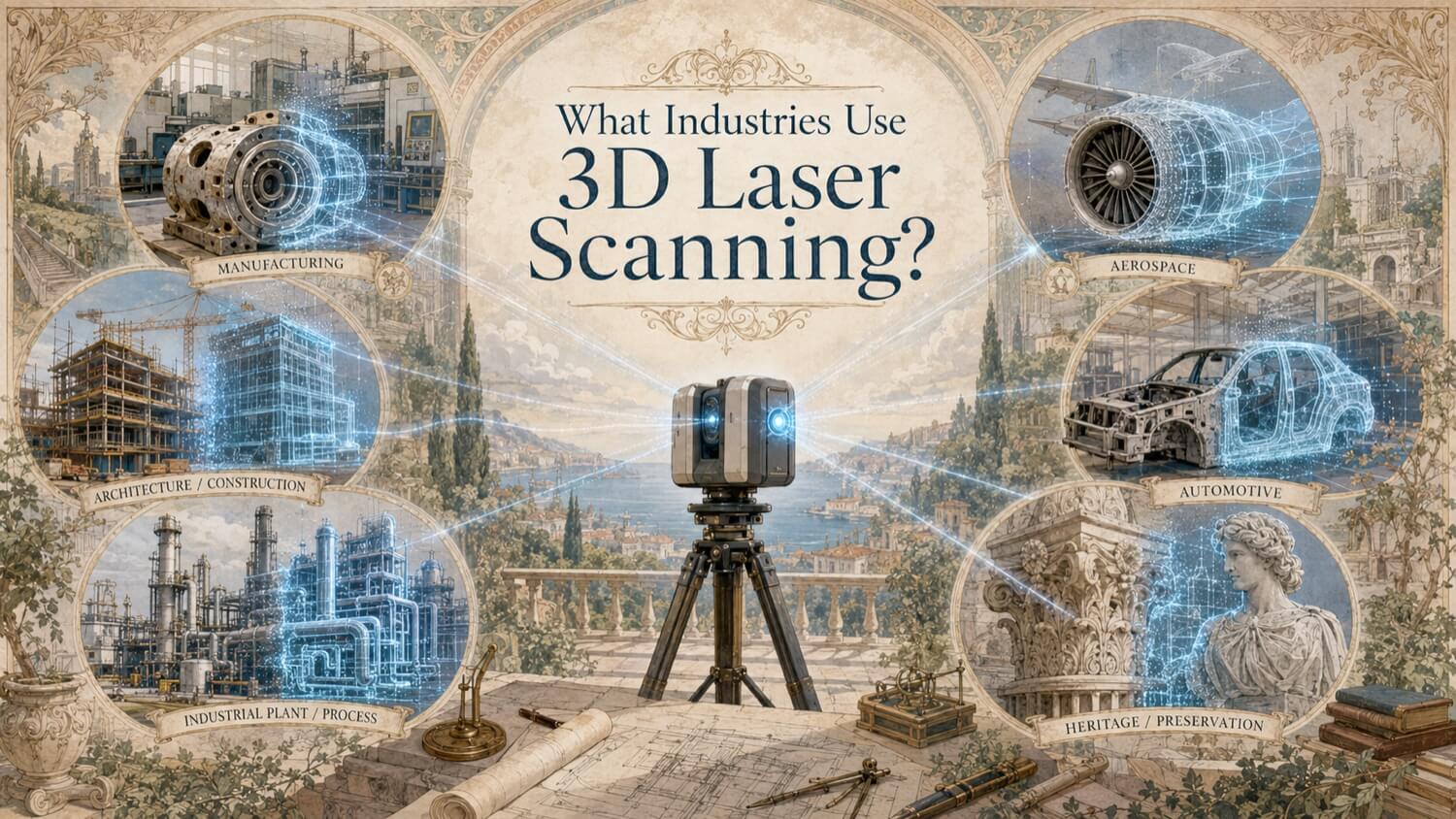
Non-contact 3D laser scanning is used across many industrial sectors where physical geometry must be documented, compared, modeled, or replicated with clear project requirements. The technology eliminates the safety risks of contact measurement in hazardous environments, compresses documentation timelines from weeks to days, and prevents the costly rework that results from relying on outdated or inaccurate drawings.
Non-Contact Measurement Across Every Industrial Sector
The common thread across every application below is a shared problem: physical reality diverges from available documentation, and that divergence creates risk , rework, safety incidents, production downtime, failed installations. 3D laser scanning resolves this problem by replacing assumption with measurement.
Oil, Gas, and Chemical Processing
Petrochemical facilities represent the highest-density application environment for industrial 3D scanning. Aging infrastructure, complex piping networks, and the elimination of shutdown windows make conventional measurement impractical.
Applications: - Brownfield renovation and expansion: Scanning existing process piping and equipment to produce as-built BIM models for new unit tie-in design - Spool prefabrication: Scanning tie-in connection points to extract exact pipe geometry, enabling off-site spool fabrication that arrives field-ready - Compressor and pump reverse engineering: Recreating obsolete impellers, seals, and housing components from worn physical samples when OEM parts are unavailable - Turnaround documentation: Capturing pre- and post-shutdown equipment configurations for engineering recordkeeping and insurance compliance
Value: Offshore platforms, refineries, and chemical plants that implement scan-to-BIM programs consistently report 60 to 80% reduction in drawing-related field rework.
Power Generation
Both conventional thermal plants and renewable energy facilities rely on 3D scanning for equipment documentation, component reverse engineering, and life extension programs.
Applications: - Turbine and generator component reverse engineering: Rebuilding obsolete turbine blades, bearing housings, and seal assemblies from worn samples - Plant as-built documentation: Capturing accurate facility geometry for control system upgrades and equipment replacements - Boiler and pressure vessel inspection: Documenting thermal deformation and structural wall thickness changes - Solar and wind foundation surveys: Capturing as-built structural foundation positions for turbine alignment verification
Aerospace and Defense
Aerospace applications often require careful inspection planning, documented methods, and clear agreement on required quality records before work begins. 3D scanning can support manufacturing quality programs and MRO (maintenance, repair, overhaul) workflows when the required documentation, tolerance basis, and acceptance criteria are defined.
Applications: - First Article Inspection (FAI): Full-surface deviation analysis against nominal CAD model per AS9102 requirements - Tooling and fixture verification: Confirming jig, fixture, and mold geometry before production release - Legacy component reverse engineering: Recreating obsolete airframe components and ground support equipment - Engine blade and vane inspection: Detecting erosion, deformation, and foreign object damage in turbine components
Heavy Manufacturing and Industrial OEM
Manufacturing facilities use 3D scanning across the full product lifecycle , from incoming part inspection through assembly verification to end-of-life documentation.
Applications: - Incoming inspection: Verifying that supplier-delivered castings and forgings conform to drawing specifications before machining - In-process verification: Checking machined surfaces against nominal CAD during production to catch errors before final operations - Mold and die wear monitoring: Tracking progressive tool wear across successive production cycles - Plant layout documentation: Capturing floor-level equipment positions for lean manufacturing cell redesign
Architecture, Engineering, and Construction (AEC)
The AEC sector uses scan-to-BIM technology for everything from heritage building documentation to complex brownfield renovation coordination.
Applications: - Historic preservation: Capturing precise geometry of heritage structures for restoration planning and archival documentation - Structural assessment: Documenting settled foundations, bowed structural elements, and deformation after seismic events - Renovation coordination: Producing as-built BIM models of existing structures to design new fit-out, MEP, and structural modifications - Construction progress monitoring: Comparing construction progress against design model to identify schedule deviations
Shipbuilding and Marine
Shipyards use 3D scanning for both new vessel construction verification and in-service vessel inspection.
Applications: - Hull fairness measurement: Verifying hull plate geometry against design lofting - Equipment foundation alignment: Confirming engine bed, shaft, and propulsion system alignment before installation - Pipe and duct routing: Capturing as-built interior routing for retrofit design - Thruster and propeller reverse engineering: Recreating obsolete propulsion components from worn physical samples
Mining and Minerals Processing
Underground and surface mining operations use 3D scanning for asset documentation and equipment reverse engineering in environments where conventional measurement is hazardous or impractical.
Applications: - Crusher and mill component reverse engineering: Rebuilding obsolete wear parts from physical samples - Conveyor and processing plant as-built documentation: Capturing plant geometry for capital project design - Underground void and tunnel mapping: Documenting excavation geometry for geotechnical stability analysis
Transportation and Infrastructure
Road, rail, and civil infrastructure projects use 3D scanning for condition assessment, heritage documentation, and renovation design.
Applications: - Bridge inspection and deformation monitoring: Detecting structural deformation and tracking changes over time - Rail tunnel scanning: Documenting tunnel geometry for clearance verification and maintenance planning - Highway corridor as-built: Capturing existing road geometry for widening and interchange redesign - Traffic control and signage surveys: Documenting sign structures and clearances
Quick Facts
Continue Reading
The next best article depends on where you are in the project. These suggested reads connect this topic to the next practical decision your team is likely to face.
FAQ
What is the most common use of 3D scanning in oil and gas?
The most common application is brownfield renovation: scanning existing process piping and equipment to produce as-built BIM models that serve as the geometric basis for new unit tie-in design, eliminating drawing-based rework during installation.
Can 3D scanning be used in hazardous industrial environments?
Yes. Non-contact scanning eliminates the need for physical contact with hazardous equipment, hot surfaces, pressurized systems, and structurally compromised assets. GDS coordinates site-specific access, safety, and documentation requirements with the client team before mobilization.
Does GDS work with aerospace quality standards?
GDS can support aerospace, manufacturing, and inspection workflows when the required scan method, comparison report, quality documentation, and acceptance criteria are defined in the project scope. Contact GDS to discuss the specific documentation your program requires.
Connect this article to the right GDS workflow
Most physical-to-digital projects touch more than one service. GDS can help determine whether the right starting point is 3D laser scanning, 3D modeling, reverse engineering, or consulting before scope, pricing, schedule, and deliverables are finalized.
GDS lists nationwide coverage from its locations page, including posted major metropolitan areas such as Houston, Dallas, San Antonio, Austin, Los Angeles, San Diego, San Jose, Long Beach, Fort Worth, Irvine, Riverside, New Orleans, Baton Rouge, Shreveport, Las Vegas, and Beverly Hills.
3D Scanning for Your Industry
GDS serves clients across oil and gas, power generation, aerospace, AEC, and heavy manufacturing. Contact us to discuss how scanning applies to your specific project challenge.