

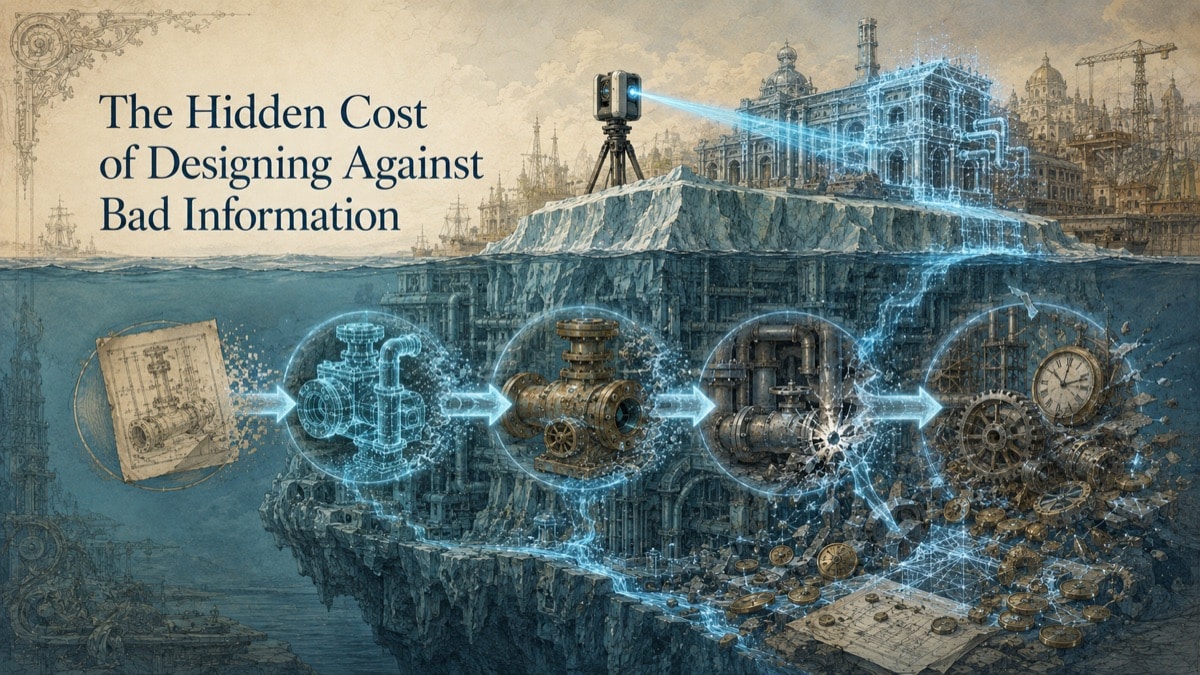
A project budget may show engineering hours, materials, contractor pricing, equipment, and contingency. It rarely shows the cost of a wrong assumption before the assumption fails. Bad information hides in the model, the drawings, the estimate, and the procurement package until construction exposes it. By then, the cost is no longer theoretical.
Designing against bad information creates hidden cost because the error moves downstream. Laser scanning can help when the risk is spatial and visible, but the case should focus on decision-critical uncertainty rather than generic promises of savings.
Key Takeaway
Bad information becomes expensive as assumptions move from early design into coordinated documents, procurement, fabrication, and field installation. Measurement can reduce selected uncertainty, but it does not eliminate every source of project change.
The Cost You Do Not See in the Budget
This is why GDS treats scanning as a decision-support workflow, not just a technical field activity. The question is not simply, “Can we scan it?” The more useful question is, “What decision must the data support, and what evidence will make that decision safer?”
Why This Matters Before Approval
Laser scanning is easiest to approve when the request is connected to a decision. A scan may support planning, design, procurement, operations, ownership, construction, inspection, or long-term asset management. The same field capture can produce very different outcomes depending on whether the team needs a registered point cloud, a model, drawings, a report, a fit-check, or consulting support.
The approval case should also state what the scan will not do. It does not automatically certify code compliance, prove concealed conditions, replace engineering judgment, or guarantee a project outcome. It provides measured visible-condition evidence and selected derivatives when the scope, access, and deliverables are defined correctly.
The Five-Stage Bad-Information Cost Chain
Phase 1 - Assumption enters the design
A team relies on an outdated drawing, incomplete model, rough measurement, or undocumented field condition.
Phase 2 - Design becomes committed
The assumption influences routing, layout, equipment, structure, fabrication, or installation sequence.
Phase 3 - Procurement locks in the error
Materials, vendor packages, or fabricated assemblies are ordered against the wrong geometry.
Phase 4 - Field discovery occurs
Construction reveals that the design conflicts with actual conditions.
Phase 5 - Cost multiplies
The team absorbs redesign, delay, rework, change management, additional coordination, and stakeholder disruption.
Why Early Measurement Can Be Cheaper Than Late Discovery
Early measurement is not free, but late discovery reduces choices. Before design is committed, the team can change geometry, sequence, or scope. After procurement or installation begins, the same discovery can require formal change control.
How to Avoid Turning Scan Data Into Another Assumption
A scan should include scope boundaries, capture date, coordinate basis, exclusions, and intended use. Otherwise, teams may over-rely on it or use it for decisions it was not designed to support.
Decision Matrix: What to Show the Audience
| Issue | Why It Matters | Practical Response |
|---|---|---|
| Bad drawing | Design route misses actual obstruction | Existing-condition scan before routing is finalized |
| Unverified interface | Vendor fabricates to wrong coordinate | Targeted tie-in capture and report |
| Incomplete site record | Contractor discovers condition late | Point cloud and scope exhibits for bid review |
| Wrong model status | Design intent treated as as-built | Model-status notes and measured baseline |
| Unclear ownership | Teams dispute what is correct | Shared evidence package and review workflow |
Table accessibility note: The table uses a plain-text header row and describes each issue, its consequence, and the practical response without relying on color.
Practical Talking Points and Decision Criteria
Use simple language when explaining scanning internally:
- We are not buying technology for its own sake; we are buying better information for a defined decision.
- The value depends on scope, access, coordinate control, deliverable format, and how the team will use the data.
- Existing drawings, photos, and site walks may still be useful, but they may not be sufficient for decision-critical geometry.
- The output should be matched to the audience: management needs the decision case, procurement needs comparable scope, engineering needs model status, operations needs an access plan, and ownership needs a maintainable record.
- Any accuracy, tolerance, schedule, acceptance, or certification language should come from the quote, proposal, inspection plan, purchase order, or statement of work.
Common Misconceptions
“Bad information is only an engineering problem.”
It becomes a management, procurement, operations, and ownership problem once it affects money, time, or commitments.
“Contingency covers uncertainty.”
Contingency may absorb some cost, but it does not restore lost time, team focus, or owner confidence.
“Scanning eliminates change orders.”
Scanning can reduce selected existing-condition uncertainty when properly scoped, but it does not eliminate all project change.
Information Cost Escalation Chain
Select where an incorrect assumption is discovered. The later the discovery, the more committed work may need to be revisited, although actual cost remains project-specific.
Quick Facts
Continue Reading
The next best article depends on where you are in the project. These suggested reads connect this topic to the next practical decision your team is likely to face.
Frequently Asked Questions
What is the hidden cost of bad information?
It includes redesign, RFIs, procurement errors, field rework, delays, additional coordination, and decisions made from assumptions.
How can laser scanning reduce this risk?
Scanning can create measured visible-condition data before design, procurement, or installation decisions are made.
Can scanning prevent all change orders?
No. It can reduce selected existing-condition risk, but scope changes, design decisions, market issues, and concealed conditions remain separate risks.
When is bad information most expensive?
When it is discovered after design commitment, procurement, fabrication, or construction mobilization.
What should leadership review?
Leadership should review the decision at risk, current information quality, consequence of late discovery, and proposed deliverable.
Connect this article to the right GDS workflow
Most physical-to-digital projects touch more than one service. GDS can help determine whether the right starting point is 3D laser scanning, 3D modeling, reverse engineering, or consulting before scope, pricing, schedule, and deliverables are finalized.
GDS supports projects nationwide. Examples from the current locations page include Los Angeles, Long Beach, Irvine, and Riverside.
Ready to Start?
Tell GDS about your asset, your goals, and your deliverable needs. GDS can scope the right scanning, modeling, and reporting for your project.