
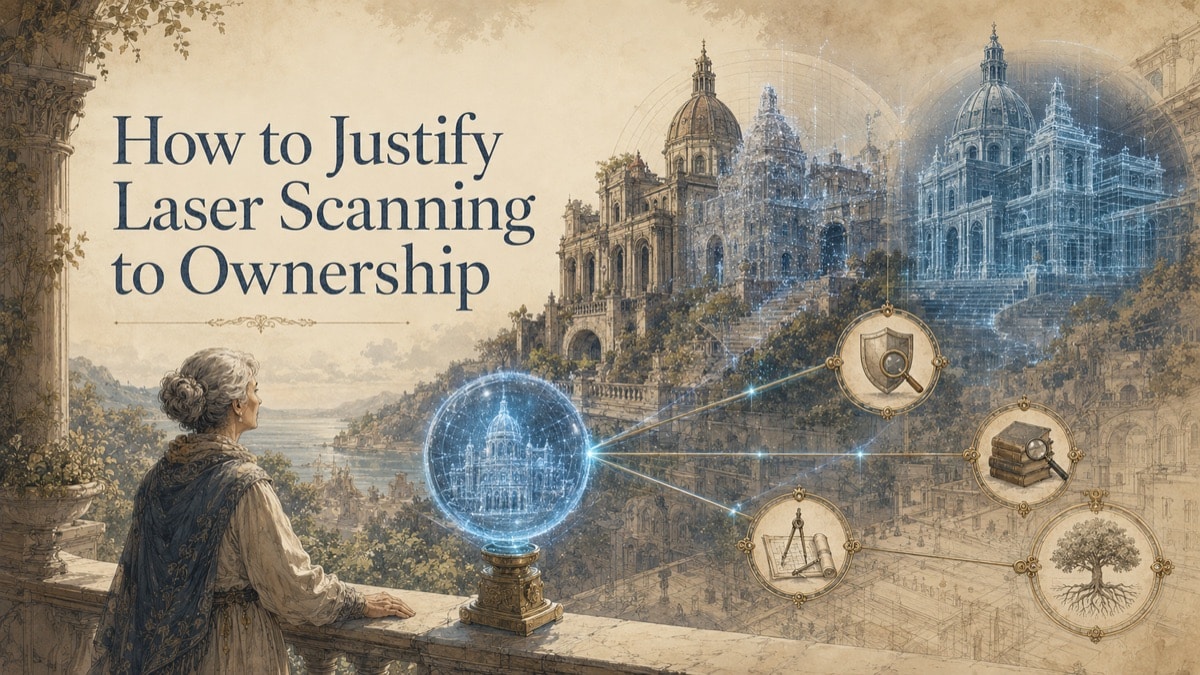
An owner may approve a renovation, purchase a building, invest in an equipment upgrade, or plan a future expansion without having a trustworthy record of the asset they already own. The drawings may be old. The model may be design intent. The O&M files may not reflect field modifications. Ownership needs a reason to invest in better information before that information is urgently needed.
Justifying laser scanning to ownership means framing the work as asset intelligence. The scan is not only for one project. When scoped and governed correctly, it can become a stronger baseline for future capital decisions, maintenance planning, tenant work, insurance review, and retrofit strategy.
Key Takeaway
Ownership gains value when the scan-derived information becomes a governed asset record that supports defined decisions. The business case should include future users, update responsibility, data access, limitations, and the cost of maintaining usefulness over time.
The Owner Record Problem
This is why GDS treats scanning as a decision-support workflow, not just a technical field activity. The question is not simply, “Can we scan it?” The more useful question is, “What decision must the data support, and what evidence will make that decision safer?”
Why This Matters Before Approval
Laser scanning is easiest to approve when the request is connected to a decision. A scan may support planning, design, procurement, operations, ownership, construction, inspection, or long-term asset management. The same field capture can produce very different outcomes depending on whether the team needs a registered point cloud, a model, drawings, a report, a fit-check, or consulting support.
The approval case should also state what the scan will not do. It does not automatically certify code compliance, prove concealed conditions, replace engineering judgment, or guarantee a project outcome. It provides measured visible-condition evidence and selected derivatives when the scope, access, and deliverables are defined correctly.
The Five-Part Owner Value Framework
Phase 1 - Identify the asset decision
Clarify whether the owner is evaluating renovation, sale, acquisition, retrofit, tenant work, due diligence, or facility management.
Phase 2 - Define the documentation gap
Explain where existing records are outdated, incomplete, inconsistent, or not usable by current project teams.
Phase 3 - Scope the owner record
Select the point cloud, drawings, BIM, CAD, spatial exhibits, or digital twin planning output that ownership can maintain.
Phase 4 - Plan governance and access
Define who owns the data, where it will live, how it will be updated, and what users can rely on it for.
Phase 5 - Connect to future value
Show how today’s scan may reduce future rediscovery, repeated site walks, and design assumptions when the asset changes.
Why Owners Should Care Before the Next Project
The cost of poor records often appears later, when a project is already in design or construction. Owners benefit when their facility record is improved before urgency removes optionality.
What Ownership Should Not Be Promised
Avoid promising that one scan solves every future question. Hidden conditions, asset changes, code compliance, system performance, and maintenance history require separate information. The owner record should state capture date, scope, and known exclusions.
How Scanning Supports Asset Strategy
Measured spatial data can support capital planning, tenant improvement, modernization, energy projects, future retrofits, emergency planning, and sale or acquisition due diligence when aligned with owner workflows.
Decision Matrix: What to Show the Audience
| Issue | Why It Matters | Practical Response |
|---|---|---|
| Capital planning | Unknown existing conditions affect budget confidence | Measured baseline for scope planning |
| Tenant work | Repeated surveys and inconsistent records | Reusable floor plans or point cloud where scoped |
| Operations | Maintenance teams rely on memory and old drawings | Current spatial reference for visible assets |
| Future retrofit | Design starts from assumptions | As-built record to reduce rediscovery |
| Asset governance | Files become stale after changes | Update triggers and revision control |
Table accessibility note: The table uses a plain-text header row and describes each issue, its consequence, and the practical response without relying on color.
Practical Talking Points and Decision Criteria
Use simple language when explaining scanning internally:
- We are not buying technology for its own sake; we are buying better information for a defined decision.
- The value depends on scope, access, coordinate control, deliverable format, and how the team will use the data.
- Existing drawings, photos, and site walks may still be useful, but they may not be sufficient for decision-critical geometry.
- The output should be matched to the audience: management needs the decision case, procurement needs comparable scope, engineering needs model status, operations needs an access plan, and ownership needs a maintainable record.
- Any accuracy, tolerance, schedule, acceptance, or certification language should come from the quote, proposal, inspection plan, purchase order, or statement of work.
Common Misconceptions
“A scan is only valuable for the current project.”
The current project may fund the data, but ownership can preserve it as a broader facility baseline when governance is planned.
“The BIM model is already the asset record.”
A design model may not reflect constructed or modified conditions unless it has been verified and maintained.
“One capture never needs updating.”
Physical changes should trigger targeted updates or clear status notes, otherwise the record will age like previous drawings.
Owner Value Horizon
Move from the immediate project toward longer-term asset use. The planning direction changes as governance and refresh responsibilities become more important.
Quick Facts
Continue Reading
The next best article depends on where you are in the project. These suggested reads connect this topic to the next practical decision your team is likely to face.
Frequently Asked Questions
Why should ownership approve scanning?
Because owners make capital, operational, and risk decisions based on facility information. Scanning can create a stronger visible-condition baseline.
Is scanning only useful for construction?
No. Owners may use scan-derived records for operations, renovation planning, tenant improvements, maintenance, and future asset strategy.
What should an owner receive?
The deliverable should match the owner’s use: point cloud, drawings, BIM, CAD, as-built report, digital twin roadmap, or a combination when scoped.
How does ownership keep the record current?
Define change triggers, update responsibilities, file storage, revision history, and who can approve updates.
Does scanning create a complete legal record?
Not by itself. It records visible captured conditions within scope; legal, compliance, and contractual status depend on governing documents and authorized review.
Connect this article to the right GDS workflow
Most physical-to-digital projects touch more than one service. GDS can help determine whether the right starting point is 3D laser scanning, 3D modeling, reverse engineering, or consulting before scope, pricing, schedule, and deliverables are finalized.
GDS supports projects nationwide. Examples from the current locations page include New Orleans, Baton Rouge, Shreveport, and Houston.
Ready to Start?
Tell GDS about your asset, your goals, and your deliverable needs. GDS can scope the right scanning, modeling, and reporting for your project.